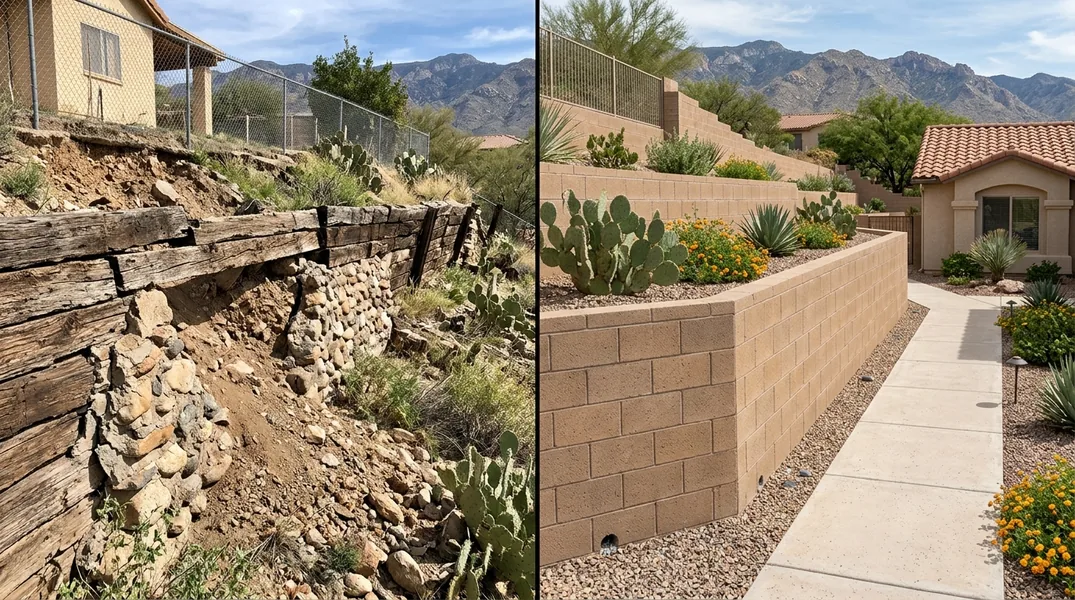
Why Retaining Walls Lean in the Desert
If you have noticed your retaining wall tilting outward or developing a noticeable lean, you are not alone. Many homeowners in Tucson face this issue after years of intense sun, seasonal monsoon rains, and shifting desert soils. Unlike walls in wetter climates, walls here must contend with rapid soil expansion and contraction, which can gradually undermine their stability. The good news is that a leaning wall does not always mean a full rebuild is necessary. Understanding the root cause is the first step toward choosing the right solution.
Common culprits include poor drainage that allows water to build up behind the wall, inadequate footing depth, and soil erosion around the base. In some cases, tree roots or nearby construction activity can also contribute to movement. Before you panic, take a close look at the wall: is the lean minor and stable, or has it worsened over recent months? A professional assessment can determine whether the issue is cosmetic or structural, and that distinction will guide your decision between repair and replacement.
Signs You Need Leaning Retaining Wall Repair
Not every lean requires a new wall. If the movement is slight, the wall is still holding back soil effectively, and there are no major cracks or crumbling, a targeted repair may be all you need. Retaining Wall Repair can address issues like minor tilting, surface cracks, and localized settling before they escalate into bigger problems. Catching these signs early is key to extending the life of your wall and avoiding costly replacement down the road.
Look for warning signs such as small cracks that have recently appeared, soil washing out from around the base, or water pooling behind the wall after a storm. If the wall is made of block or stone, check for loose or displaced units. A qualified contractor can use techniques like underpinning, drainage correction, or crack injection to stabilize the wall and restore its function. For many homeowners in Oro Valley and surrounding areas, timely repair saves both money and hassle.
When Retaining Wall Replacement Is the Better Choice
Sometimes repair is simply not enough. If your wall is leaning significantly, has large horizontal or diagonal cracks, or is bulging outward, the structural integrity may be compromised beyond what patching can fix. In these cases, Retaining Wall Replacement is often the safer and more cost-effective long-term solution. A wall that is failing can pose a risk to property and safety, especially during monsoon season when saturated soil adds extra pressure.
Replacement also gives you the opportunity to upgrade materials and construction methods. For example, switching to Concrete Retaining Walls can provide superior durability and require less maintenance in our harsh climate. A new wall can be engineered with proper drainage, deeper footings, and reinforced backfill to prevent the same problems from recurring. While replacement is a larger investment upfront, it often pays off by eliminating repeated repairs and protecting your landscape for decades.
Retaining Wall Crack Repair: What to Know
Cracks are one of the most common reasons homeowners seek professional help. While hairline cracks may be purely cosmetic, wider cracks can indicate movement or water intrusion. Retaining Wall Crack Repair involves more than just filling the gap; it requires identifying why the crack formed and addressing the underlying cause. If the crack is accompanied by a lean or bulging, it is a red flag that the wall may be nearing the end of its service life.
Professionals typically use flexible sealants, epoxy injection, or re-pointing techniques depending on the wall material. However, if cracks are widespread or growing, repair may only be a temporary fix. A thorough inspection will help you decide whether crack repair is a viable option or if replacement is the wiser path. Ignoring cracks can lead to bigger structural issues, so it is best to have them evaluated promptly.
Retaining Wall Replacement Cost in Tucson: What to Budget
Homeowners often ask about pricing before deciding between repair and replacement. The cost of replacement varies based on wall height, length, material choice, and site access. On average, replacing a retaining wall can range from a few thousand dollars for a small wall to significantly more for large, engineered structures. Repair costs are generally lower but depend on the extent of the damage and the methods required.
It is important to get a detailed written estimate that outlines the scope of work, materials, and timeline. A reputable contractor will also discuss drainage solutions and soil conditions specific to your property. While it may be tempting to choose the lowest bid, quality and experience matter, especially in a desert environment where proper installation is critical. Investing in a properly built wall now can save you from costly repairs later.
Retaining Wall Repair Near Me: When to Call a Pro
If you are searching for "retaining wall repair near me" in the Tucson area, it is a sign that you are ready to take action. DIY fixes are rarely sufficient for structural issues, and attempting to repair a leaning wall without proper knowledge can make the problem worse. A professional can assess the situation, explain your options, and provide a clear recommendation tailored to your budget and goals.
Do not wait until a small lean becomes a major failure. Contact Tucson Retaining Wall at (520) 467-5911 to schedule a free estimate. Our team serves homeowners throughout Tucson, including South Tucson and Marana, and can help you decide whether repair or replacement is the right choice for your property. Protect your landscape investment with expert guidance and quality workmanship.
Looking for a professional retaining wall contractor in Tucson? Tucson Retaining Wall responds fast for all your retaining wall needs.
Get a Free QuoteOur services: Retaining Wall Installation · Retaining Wall Repair · Retaining Wall Replacement