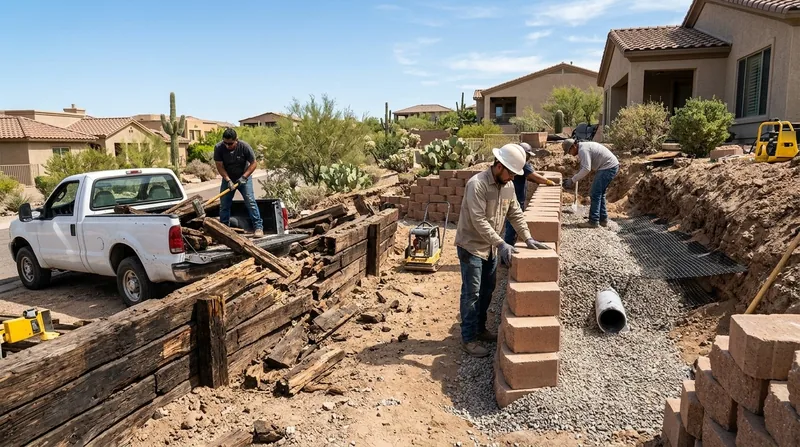




Tucson sits in a broad desert basin that climbs hard into the Santa Catalina, Rincon and Tucson Mountain foothills, and every one of those slopes eventually pushes against a retaining wall. From the stuccoed CMU and mortared river rock walls of Sam Hughes and Armory Park to the granite boulder beds holding cut-and-fill lots in the Catalina Foothills and Starr Pass, walls here take a beating that few other climates deliver. Caliche hardpan traps water against the back of the wall, pockets of expansive clay swell and shove, decomposed granite washes out of the joints, and July through September monsoon cloudbursts turn dry arroyos into torrents in minutes. When a wall has already leaned, cracked, or dropped a course of block, patching it is usually money thrown at a symptom. Retaining Wall Replacement in Tucson means tearing out the failed structure down to the footing, hauling it off, rebuilding the drainage that was missing in the first place, and setting a wall that is engineered for this ground. We handle the full tear-out and rebuild, and if you are still deciding between repair and replacement, start with our retaining wall repair page to see where the line falls.
Why Retaining Walls Fail in Tucson and Why Replacement Beats Another Patch
The dominant failure mode in this city is water, not age. Caliche forms an almost concrete layer under many Tucson yards, so monsoon runoff cannot percolate down and instead loads the back of the wall until it bulges or tips. Add expansive clay that swells after a storm, decomposed granite that migrates out through weep holes, and decades of hard white sun baking the mortar out of slump block, and you get the leaning walls we see from Flowing Wells to Vail. Railroad tie beds from the 1970s and 1980s are the worst offenders because the timber rots from the inside out and the deadmen pull loose.
- Walls built without gravel backfill or drain pipe trap water and fail within a few monsoon seasons.
- Slump block and stuccoed CMU crack along the mortar joints when the footing sits on expansive clay.
- Timber and railroad tie walls rot at the soil line and lose their tieback anchorage.
- Hillside walls in the Catalina Foothills and Oro Valley undercut when decomposed granite washes out from below.
- Older walls built before modern surcharge rules sag when a driveway or patio was added behind them.
Once the footing has moved or the wall has rotated past a few degrees, replacement is the only fix that holds. For walls that are already failing, our leaning and collapsed wall repair service covers the emergency side of that work.
Key info: A mortared river rock wall in Sam Hughes that leans because caliche is holding water behind it will keep leaning after any cosmetic repair. We tear it out, break the hardpan drainage path, and rebuild with gravel backfill and a perforated drain pipe that outlets to daylight.
Permits matter here. Many jurisdictions in the Tucson area require a permit for walls above roughly 4 feet measured from the footing, or whenever the wall supports a surcharge such as a driveway or structure, and engineered drawings may be needed for tall or tiered walls. Thresholds vary by jurisdiction, so confirm with the local building department before work starts. You can check the City of Tucson's permit guidance at tucsonaz.gov.
How We Replace a Failed Wall in Tucson, Step by Step
Replacement is a demolition job first and a construction job second. We walk the site, identify what is actually holding the slope, and check where the water is coming from before anything gets torn out. On hillside lots in the Catalina Foothills and Starr Pass we also check the uphill grade and any surcharge loads, because a wall that only holds dirt is a different build than one holding a driveway. Then we sequence the tear-out so the slope is never left open longer than necessary.
- We inspect the wall, footing, and drainage path, and confirm permit requirements with the local building department.
- We demo the failed wall and haul away block, rock, timber, and spoiled backfill.
- We excavate to sound bearing soil and pour or set a new footing sized for the wall height and soil.
- We install gravel backfill, filter fabric, and a perforated drain pipe that outlets to daylight.
- We build the new wall in the material that suits the site, then compact and grade the slope behind it.
- We clean the site, walk the finished wall with you, and hand over any inspection paperwork.
Every replacement we finish gets a drainage system sized for monsoon flow, not a token weep hole.
Key info: A 1970s railroad tie wall in Flowing Wells holding a backyard that steps down to a wash is a typical call. We pull the rotted ties, haul them out, and rebuild with segmental block and a proper drain that sends storm water to the street instead of into the neighbor's yard. See our railroad tie wall replacement page for that scope.
Replacement Approaches We Use Across Tucson
The right replacement material depends on height, soil, load, and what the wall has to match. A stuccoed CMU wall in Armory Park usually needs to look like the block wall next door, while a foothills lot may want granite boulders that blend into the slope. We pick the system after we see the soil and the water path, not before.
| Approach | Description | Best for |
|---|---|---|
| Segmental block (SRW) | Engineered interlocking block with gravel backfill and drain pipe. | Tiered hillside walls and walls that need geogrid reinforcement. |
| Poured concrete | Reinforced concrete wall with formed face and proper footing. | Tall walls carrying surcharge loads such as driveways. |
| Stuccoed CMU or slump block | Grouted block wall finished to match the neighborhood. | Barrio Viejo, Sam Hughes, and midtown lots with a stucco look. |
| Boulder and natural stone | Granite boulders set into the slope with gravel drainage. | Catalina Foothills and Tanque Verde lots that need a natural look. |
| Gabion baskets | Rock-filled wire baskets along washes and steep banks. | Erosion control where arroyos run hard in monsoon season. |
We match the approach to the site, and we do not sell a block wall where a boulder wall is the honest answer.
Retaining Wall Replacement Cost in Tucson: What to Expect
Replacement pricing starts at From $35/sq ft for a standard tear-out and rebuild, and that figure is a starting point, not a quote. The number moves with wall height, access, soil conditions, and how much of the old wall has to be cut out by hand. A wall in a tight side yard in Casas Adobes where a machine cannot reach costs more per foot than an open lot in Sahuarita, and a wall that needs engineered drawings and a permit adds design and inspection time.
Soil is the other big variable. Caliche that has to be broken out with a breaker, expansive clay that requires over-excavation, and decomposed granite that needs stabilization all add labor. So does hauling: old block, rock, and rotted timber have to leave the site, and disposal is a real line item. Getting two or three estimates is smart because the scope has to be compared line by line, especially the drainage work, which is where cheap bids cut corners. Our full pricing overview breaks down how we build a number.
What to Look for When Hiring a Retaining Wall Contractor Near Me in Tucson
Hiring for a wall replacement is different from hiring for a repair, because the contractor is taking on the slope itself. Start with fully insured status and ask for the certificate, not just a verbal yes. Then get at least two or three written estimates that spell out the drainage design, the footing, and the disposal, because those are the three places a low bid hides its savings. Check references on walls of similar height and soil, and ask how the contractor handled monsoon water on those jobs.
Permits and HOA rules come next. Many Tucson-area jurisdictions require a permit above roughly 4 feet or when the wall carries a surcharge, and engineered drawings may be required for tall or tiered walls. If your lot is in an HOA in Oro Valley or Green Valley, get the architectural approval in writing before demolition starts. Setbacks and property-line rules also apply, so confirm the wall location on a survey if it sits near a lot line. If you want to talk through your wall, contact us for a free estimate and we will walk the site with you.
Retaining Wall Replacement in Tucson: Pricing Guide
| Service | Price | Details |
|---|---|---|
| Standard tear-out and rebuild | Starting at $35/sq ft | Includes demolition, haul-away, new footing, gravel backfill, and drain pipe for a typical wall. |
| Tall or surcharge wall | Starting at $55/sq ft | Engineered wall carrying a driveway or structure, with design, permit, and inspection time included. |
| Railroad tie or timber replacement | Starting at $40/sq ft | Rotted tie removal, disposal, and rebuild in block or boulder, priced by length and access. |
| Complex or large-scale job | On estimate | Tiered walls, steep foothills lots, and caliche excavation need an on-site look before pricing. |
| Travel | Included | In Tucson and surrounding areas, no separate call-out or mileage fee. |
| Estimate | Free | Response within 24h at (520) 467-5911, no obligation to book. |
Indicative pricing, the exact cost depends on square footage, finish, and site access. Free personalized estimate within 24h at (520) 467-5911.


