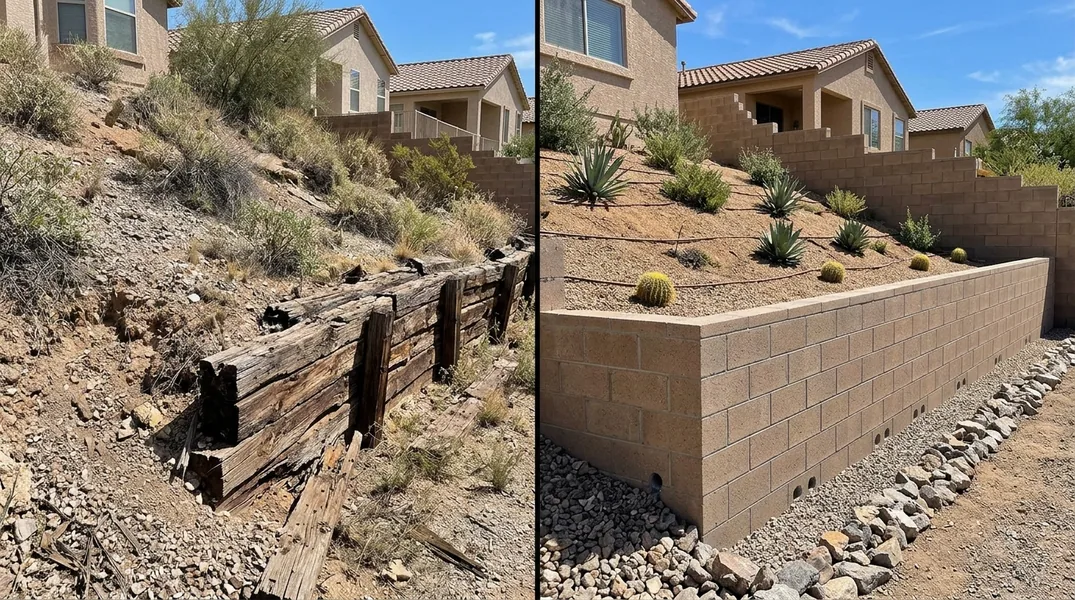
Why Tucson's Soil Makes Retaining Wall Material Choice Critical
If you live in Tucson, you already know that digging a hole here is not like digging a hole in most of the country. Caliche, that cemented layer of calcium carbonate, can stop a shovel cold and send project timelines sideways. Decomposed granite on foothill lots adds its own challenge: it shifts, drains unpredictably, and behaves very differently from the clay soils many national guides assume. That is why the best retaining wall material for a Phoenix or Midwest yard is not automatically the best choice here.
The material you choose needs to handle three local realities: expansive or cemented soils that push laterally, intense sun that degrades some finishes, and seasonal monsoon water that needs somewhere to go. A wall that ignores any one of these will crack, lean, or fail early. Whether you are planning a new build or considering Retaining Wall Repair on an existing structure, understanding how each material performs in caliche and decomposed granite is the first step toward a wall that lasts.
Concrete Retaining Walls: The Heavyweight for Caliche and Tight Lots
Concrete Retaining Walls are often the go-to choice when soil conditions are stubborn and space is limited. Poured concrete can be engineered to resist the significant lateral pressure that caliche and expansive soils generate, and it takes up relatively little horizontal room compared to a boulder wall. On a tight foothill lot where you cannot sacrifice yard space, that footprint advantage matters. Concrete also holds up well under the intense UV exposure we get here, especially when it is sealed and finished properly.
The trade-off is cost and appearance. Poured concrete typically carries a higher upfront pricing than block or boulder options, and some homeowners find raw concrete visually cold. Texturing, staining, and decorative finishes can soften that look, but they add to the budget. If you want a wall that will handle the worst soil pressure with minimal maintenance, concrete is hard to beat. If curb appeal and natural integration with a desert landscape are top priorities, keep reading.
Block Retaining Walls and Segmental Systems: Versatile and Repairable
Block retaining walls, particularly segmental retaining wall systems, have become the most popular choice for residential projects across Oro Valley and the greater Tucson area. These interlocking units are designed to flex slightly with soil movement rather than crack, which is a real advantage in decomposed granite where minor settling is common. Segmental systems also drain well when installed with proper gravel backfill and geogrid reinforcement, and that drainage is essential during monsoon season.
One underrated benefit of block and segmental walls is serviceability. If a section shifts or a few units are damaged, a skilled crew can often disassemble and rebuild that area without tearing down the entire wall. That makes future Retaining Wall Replacement or repair far less disruptive. Block walls come in a wide range of colors, textures, and profiles, so they can mimic natural stone or read as a clean modern line. For most homeowners balancing cost, durability, and looks, segmental block is the sweet spot.
Boulder Retaining Walls: A Natural Fit for Foothill Lots
On foothill properties where the goal is to work with the landscape rather than against it, boulder retaining walls are a beautiful and practical option. Large native or quarried boulders handle decomposed granite slopes well because their mass and irregular shape let them nest into the terrain. They also blend seamlessly into desert surroundings, which is why you see them throughout the foothills communities near Marana and the Catalina foothills. A well-built boulder wall looks like it belongs there, not like it was dropped in.
Boulder walls are not a fit for every site, though. They need enough room for the stones to be placed and chinked properly, and they work best on slopes rather than as tight vertical walls. Very tall boulder walls can also require engineering to ensure stability. When the site allows it, boulders offer excellent drainage and a timeless look with very low maintenance. The key is having an installer who understands how to seat each stone for long-term stability rather than just stacking rocks.
Retaining Wall Installation Near Me: Matching Material to Your Site
The honest answer to "which material is best" is that it depends on your specific soil, slope, space, and budget. A caliche-heavy lot with limited room often points toward concrete or engineered segmental block. A decomposed granite slope with room to spread out may be ideal for boulders. Many projects combine materials, using block for the structural height and boulders or veneer for the visible face. A professional site assessment is the only way to know for sure, and that is exactly what a proper Retaining Wall Installation consultation should include.
If you are tired of searching for "retaining wall installation near me" and getting generic national advice, it is worth talking to a local crew that deals with caliche and decomposed granite every week. Tucson Retaining Wall serves homeowners across the area and can walk your property, evaluate drainage and soil, and recommend the material that will actually hold up. Call (520) 467-5911 or request a free estimate to get started.
Retaining Wall Cost in Tucson: What to Budget
Budget is usually the deciding factor, and retaining wall cost in Tucson varies widely based on material, height, length, and site access. As a general guide, boulder walls tend to be the most affordable per square foot when the site allows them, segmental block falls in the middle, and poured concrete sits at the higher end because of forming and engineering requirements. Caliche excavation can add cost on any material, since breaking through that layer takes specialized equipment and time.
Height matters more than most homeowners expect. Walls over a certain height typically require engineering, geogrid reinforcement, and permits, all of which affect the final number. Drainage work, backfill, and hauling also contribute. The best way to get a realistic figure is a site-specific quote rather than a national average. A local installer can account for your actual soil and slope, which is the only way to budget accurately. Reach out for a written estimate before you commit to a material.
Looking for a professional retaining wall contractor in Tucson? Tucson Retaining Wall responds fast for all your retaining wall needs.
Get a Free QuoteOur services: Retaining Wall Installation · Retaining Wall Repair · Retaining Wall Replacement